Monday, February 04, 2008

A New Market for Tech Entrepreneurs - User Content.

(User) Content is King


With all the buzz about Microsoft's mission to own Yahoo! and their recent investment in Facebook (for a ridiculous valuation) - it shows a clear sign that we are entering a new era for the entrepreneur and the tech economy. Not only are the big tech companies re-defining their 10-year vision, but the "users" are truly in control of the market for the first time.

Here is why the "users" are in control:

1. Software is Free. Whether you download freeware or make your own, software is no longer being purchased by the masses. In fact, users have taken the initiative to build their own. "Open Source" has been a buzz word for a long time, but it was too complex to implement and build market share. What needed to happen was the "cycle" of users to get sick of paying top dollar for software, and for the Open Source and Shareware market to spawn "market-driven" companies that upholds the spirit of sharing and "free use", but can build a solid product. In the next five years, users won't pay for software - and they shouldn't because most of the crap on the shelves is way over-priced and not meeting the needs of the average user. There is an adjustment happening right now, that is forcing software companies to adapt to a web-based model, and be more aggressive on pricing.

2. Social Networks and Blogs are dominating traffic. For the first time, Users are truly making the decision on where they go on the web. I know it sounds weird - but for a long time, users were driven to websites by the advertisers. Five years ago, a user would hit a website because they saw an ad, and rarely because of "word-of-mouth" or through smarter search engines. Now, with better search engines, social networks and an Internet where users determine what is good content (ala Digg, Social Bookmarking, etc) - the advertisers don't have enough money to move users to where they want them to go. Now users are driving most of the content, and also driving the trends of traffic. This poses a major problem for media and anyone that intends on selling traffic - because the user is now in control of the wheel and (by the way) can skip the middle man and make money from their own content and traffic.

3. Users are the economy. The shift that is happening is actually very scary. The web economy has always been based on some of the same basic elements of any media - users, clicks, impressions and transactions. And for the most part, there was a middle-man to broker all these products. The is no better example than Google, who is essentially brokering the users time on the web to advertisers. Every page you visit, they display ads... you click on the ad.. they make money. BUT! there is a problem in this model. Google is assuming that users will continue to "aimlessly" browse the web, and not learn and become a "smarter" user. This is the flaw in their model, and ultimately I believe will effect their business. Just like the banner ad business in the late 90's... people at first would click on banners - but then would naturally start ignoring the banners because they typically did not go to a content-rich website, but instead tried to sell them product they didn't want. The "Google Ads" will fall victim to this as well, and when users stop clicking Google Ads.... the Content owners will start to look for other options. The entire "Google Economy" is dependant on user behavior. Why would people stop clicking on ads? Simply... because they no longer use the web to simply search aimlessly - but not have "stuff to do" - the rise of blogs, social networks and other web-based applications takes away time from surfing and thus aimless ad clicking. Don't believe me - read about why Google is reporting a poor performing quarter. They claim users on social networks aren't clicking ads. People aren't searching anymore... they are using the web - and the "ad-based" economy will suffer.

So my point is this - if you are looking for the next killer app? Focus on this trend. If you are building a product that you are licensing (software), or selling advertising (PPC, etc) - then you may want to reconsider your model.

If you want to make money - you will need to provide real value to the user and allow them to share or dominate your profits - and embrace the new economy on the Internet, where it is completely based on one thing - "User Content". The days of clicks, impressions and licenses are over.

Sunday, January 27, 2008

10 SIMPLE STEPS TO CHANGING AMERICA

Before you read my "rant" - I would like to first admit that I do NOT pretend to know more about politics, government or economic theory than the average person. However, I always feel like a different perspective than what is offered in talking points by the two parties is always refreshing.

The following is an entrepreneurs take on the big issues facing the country. I am not for making the government more powerful - but I am for making the government more focused and efficient.

Here we go. 10 simple ways the government can change the course of America.

#1 - Term Limits - Eliminate "career" politicians. Only allow any elected official to have a maximum of 8 consecutive years in office.

#2 - Flat Employment Tax + Consumption Tax - I realize the Tax code is complex. But at the end of the day - why is it so difficult to implement a tax code that can be based on simple concepts like "The more you use, the more you pay" and "The more you invest, the more you get back".... We always talk hear "this reform hurts the poor" or "this will over-tax the rich".... what I am looking for is a tax reform that taxes people that take and do not give back. For example, if a millionaire invests money into the US economy or jobs - he gets the benefit that outweighs the tax he gets hit with on his beach-front home. However, if a millionaire is not investing in charity, the economy - but simply taking and not giving back - he should be taxed. The best way to save our economy and support entrepreneurship is to recognize those people who help our economy and our community - and penalize those who don't.


#3 - Take Guns off the Street - I know, I know - The Constitution says we have the right to bear arms. Ok, I get it. However, I think the spirit of this was to protect our homes in defense. So here is my proposition - no concealed permits. No carrying firearms in public. If you want to protect your home, or go kill some deer - fine. But no guns on the streets. Also, no automatic weapons. We have a major problem with violence in this country... and Government can't change the way we raise our kids - but the least it could do is stop allowing the sale of semi-automatic weapons. (If you are thinking "Screw you - I need my guns" - wait until your 13 year-old son is shot at school... then tell me if the 2nd Ammendment can bring back your boy)

#4 - Stop Credit Card Companies from becoming Loan Sharks - To many people are given too much credit by banks. Many times with outrageous interest. This country is too dependant on credit. It has become an addiction. I don't see why abusing credit is not too different than gambling. The credit card company is the loan-shark, giving you points on money you know you can't pay back. Don't get me wrong - I think Credit is a powerful tool for people to buy homes, cars and other necessities in life - but I think the credit companies need to stop abusing their license to loan. I think the government needs to regulate banks and how they issues credit cards (not all loans). The first step is make it illegal to solicit business through mail. They make it too easy for people to fall victim to their "scams". (Personally, I think all junk mail should be illegal... but this is one that would make a difference)


#5 - Make All Utilities (including Gas) Tax deductable - What a great way to create a check and balance system for "Big Oil" and Government. Not only does it motivate Government to find ways of keeping our energy costs low, but it also makes them feel the pain and focus on smarter energy. This also helps the poor guy who makes minimum wage who drives 60 miles to go to work - and at the same time helps the rich guy who has a yacht and needs to gas it up every weekend. Its a win-win-win.

#6 - Mandate Insurance Rebates - One of the big issues facing many people is the rising rates of insurance (home, risk) and even professionals like doctors are getting killed on insurance for mal-practice. Yes, insurance is necessary - and I realize the system is very complex. But here is a simple way we can help (again, using my simple philosphy of those who do good, receive the benefit). Create Insurance Rebate system where those people who DON'T get sick, or DON'T wreck their car, or DON'T get sued for mal-practice receive a rebate on their insurance. So for example, if I pay $3,000 a year in health insurance, and I don't go to the doctor that much - then I get a rebat of X% that is applied to next years bill. Perhaps its $600 I get back and then I only pay $2,400 next year. Again - this mirrors my thoughts on how taxes should work - based on consumption and abuse. (Also, I look at this like a win-win - because the insurance companies will retain their customers, and motivate them to think twice before driving fast or reporting a false claim - this is clearly a WIN-WIN).

#7 - BUILD INFRASTRUCTURE FOR 2050 - I know this may sound weird - but call me a futurist. Let's look at the basics of why economies flourish, and some die. One of the basic components of having a thriving economy is "access". Remember the old days - before railroads, before the steam engine - not much economy was there? It's not different today. We need to invest billions in our infrastructure. We need to make every major highway bigger. We need to build more high-speed trains, and improve our cities core infrastructure. Congested traffic means less people leave their home to spend money. More traffic means more wasted energy. The more difficult for people to get to and from work - makes it hard for the average american to make a living. We need better infrastructure, new highways, and a new vision for transportation. We need to plan for the next 50 years.

#8 - Pay Kids for attending and accelling in school - Simple. Back to the core concept of "do good, and you will be rewarded" - this is the basic of the American Dream. Work hard, and good things will come. Why not teach this to our youth? For kids to maintain certain grades - we should reward them. Not with stickers and smiley faces. We should reward them with money. Why? because they deserve it. They probably deserve it more than the millions of people on welfare that could get a job, and decide its not worth the effort. I can't think of a better place to invest than Education. How do we pay for it?? Simple - State lotteries, tax rebates to large corporations in the short term - and in the long term it will pay for itself - because we will have more tax payers, less dropouts, less crime and less welfare to pay out.

Another reason why this is a great idea - the money will go directly back into our economy. The money we pay out to kids will go right into our service and retail economy. Maybe (just maybe) some of it will go to a savings account.

Here is some perspective. There are about 50 million kids in high-school and elementary school. Lets say we paid those kids who stay in school (based on attendance) $100 per semester ($400 per year). And for those kids who maintain a 3.0 GPA we pay $200 per semester ($800 per year). Assume we paid out 80% (probably way too high) of kids with good attendance. It would be about 40 Million kids with good attendance = $16 Billion and for good GPA (20% of kids) = $8 Billion. So call it roughly - $25 Billion dollar program per year. Sounds like a lot??? Not really - we have spent $500 Billion on the War in Iraq (that is basically 20 years of my Education Incentive program)

#9 - Tax E-Mail - Don't call me a liberal. I hate taxes as much as you do. But this is actually something that makes sense to me as a taxpayer and someone who hates "Spam" :).

Here are the staggering stats - Over 90 billion messages a day are sent over email. Of which 90% is spam. So lets call it 80 Billion unwanted emails.

I don't think "spam filters" are the solution. If you want to kill something - tax it. So this is actually one of the few times I agree with a tax. Let's say we said "For every email sent we taxed it a penny" (maybe we have an exception that reads "each person is allotted 1,000 emails per month) - this avoids for individuals from the freedom of using the web. The target here are the companies that send millions of "spam" messages a day.

One of two things will happen - Spam will stop - or the government makes money on its new tax. 80 Billion messages per day will result in over $300B a year in tax income. Guess what - I just paid for half my suggested programs above AND reduced annoying emails in your inbox.

#10 - Reward the Family - In my opinion the long-term solution to all the social challenges the country faces - is getting back to supporting the basics - the family. Specifically, there are simple things we can do to rebuild confidence in the american family and show that the government rewards those who work hard. One of the biggest changes I believe could help build stronger support for the family is giving single-income homes and small business owners (entrepreneurs) tax advantages. Today we penalize people for "going on their own to start a business" and we penalize "parents who stay home and choose to raise their children". Maybe I am confused - but aren't these the very things we need to encourage - or atleast support? I am not trying to tell women (or men) to stay at home and not chase their dreams... instead, I am saying "for those who stay at home to focus on family - or for those who are creating businesses and jobs - we want to support you."

I am sure I can think of a few more - but I think 10 is nice round number. If I think of something, I will make sure I add it. Of course my goal was to outline some very simple ways government can re-align with American values, and without over-taxing or being "big-government" - ways that it truly could change the course of America for the better. (atleast I think so).


Thursday, December 13, 2007

A New Market Crash


I don't pretend to be a financial wizard, or someone who follows the market on a daily basis. I rarely watch C-Span and occasionally login to my Ameritrade account.

However, I do have a point to make about markets and how it relates to the small (new) business of entrepreneurs.

About six years ago, when the technology market crashed, it was a tough time for a lot of entrepreneurs, and in looking back a lot of good things came out of the boom that changed the world (Google, eBay, etc), but a lot of entrepreneurs sufferred tremendously and many lost everything.
Now we are looking at the same type of impact on the economy with the recent Real Estate crash, but for some reason it feels different to me.

When innovative (small) businesses die - the best an entrepreneur / Investor can hope for is a write-off on their taxes. When the real-estate values drop the entire government mobilizes and tries to find ways to reduce the burden on banks and the overall market by lowering interest rates, writing off loans and shifting policies. It seems a little odd, that our "innovation" economy doesn't get the same type of attention when markets dip?

I know what you are thinking "Its different... because starting a new business is part of capitalism and there is assumed risk - the government should not be there to bail you out"

I agree - starting a new business is risky, and the governement shouldn't bail out the entrerpreneur - but in the same breath - realize most of the real estate crash is due to "investors buying over-valued real estate". How is this different? It is still buying stock in an asset, and trying to profit from the sale. Sounds like a business to me.

Don't get me wrong, I am not asking the government to bail failing businesses out - but what I am asking is for entrepreneurs and early-stage investors to be given the same level of relief that we are seeing in the Real Estate aftermath.
What about finding ways to encourage more early-stage investment in companies and ways to offer "relief" through taxes for entrepreneurs who risked their money and lost it in a new venture.

What about lowering the tax burdens of entrepreneurs who provide a sole income to their family, or invest in new companies to grow the economy?

I am not claiming to have all the answers - but I find it a little odd that when the real estate market crashes the President and Congress get out of bed the next day and scramble to find a way to lessen the burden on Corporate America - but when the Innovation Market crashes - they let the entrepreneur and small business owner take the hit.


Saturday, August 18, 2007

Here is the Committee for the Opportunity Fund???

First, let me say - that all of these guys chosen for the Florida Opportunity Fund are very successful, and I am sure very bright. However (with all due respect) - are they the right people to make decisions about where "Early Stage Venture Capital" should go in Florida?

Here is the committee:

Jeff Lyash - Energy Executive
Jeff is an executive at Progress Energy, and has worked with Nuclear Power Plants his entire career according to his bio. No clear Startup or Entrepreneurial experience. http://www.progress-energy.com/aboutus/executive/lyash.asp

Alan Becker - Lawyer
Alan is a very successful lawyer - with expertise in International Law. Lawyer his entire life. No clear Startup or Entrepreneurial experience. http://www.becker-poliakoff.com/attorneys/bios/becker_a.html

Cyrus M. Jollivette - Health Care Executive
Cyrus' entire career is in Public Relations with Government and Universities. No clear Startup or Entrepreneurial Experience. http://www.flchamber.com/mx/hm.asp?id=bd_jollivette

Tim Edmond - Real Estate
Tim has developed real estate for 27 years. No clear Startup or Entrepreneurial Experience.
http://www.cnl.com/teamprofile.asp?exec=42

Medhi Ghomeshi - Banker
Medhi is a banker. No clear Startup or Entrepreneurial Experience.

So basically, no one that has run a VC firm, no one that has started and grown a successful startup, and no one who has embraced innovation and risk.

One could argue that Energy, Real Estate, Law, Banking and Health Care are "high risk" ventures. But that person would be wrong. Dead wrong.

Five members to pick decision makers for VC Fund

This is an article just released by Tampa Bay Biz Journal. You can see my comments below.

http://www.bizjournals.com/tampabay/stories/2007/08/13/daily70.html


Five members to pick decision makers for VC Fund

Tampa Bay Business Journal - 5:23 PM EDT Friday, August 17, 2007
by Danielle Randall

The first state-backed venture capital fund has adopted a committee.
Enterprise Florida Inc., the state's economic development and retention organization, is in the midst of creating a Florida Opportunity Fund. The fund will invest $30 million of its total of $35 million to invest seed capital and early stage venture capital funds.

Tom Kuntz, vice chairman of Enterprise Florida's board and chairman, president and CEO of SunTrust Bank Inc. (NYSE: STI) in Florida, appointed five existing EFI board members to serve on the committee during this week's board meeting.

The committee members are Jeff Lyash, president and CEO, Progress Energy Florida Inc., Raleigh, N.C.; Alan Becker, senior partner for Becker & Poliakoff, PA Fort Lauderdale; Russ Jollivette, senior vice president of public affairs, Blue Cross/Blue Shield Florida, Jacksonville; Tim Edmond, president of CNL Realty & Development Corp., Orlando; and Medhi Ghomeshi, president and chief executive officer of Great Florida Bank, Coral Gables.

These committee members do not exactly seem like entrepreneurial businessmen, considering each of them work for large companies that do not likely work with startups, said Rich Swier, founder of Sarasota-based StartupFlorida, which has an investment concentration in the Tampa Bay region.

"They're executives and bankers, and I don't believe any of these people are rubbing elbows, or working closely with early-stage venture capitalists," Swier said.

During the next three months, the committee will cherry pick a list of potential decision makers for the Florida Opportunity Fund. Its short list of candidates will be voted on at Enterprise Florida's board meeting Nov. 15.

The Florida Formation Act was enacted July 1 in an effort to fuel the economic development of startups and venture capital investments in Florida. As part of the legislation, the Florida Opportunity Fund will be established as part of the legislation and will earmark $30 million of its $35 million to in invest in seed capital and early stage venture capital funds. These investments would not go directly to individual businesses but would be comprised of a partnership with private venture capital funding, or through a fund-of-funds investment approach. Fund-of-funds is a vehicle designed to invest in a diversified group of funds.

Friday, July 20, 2007

Update on the Florida Opportunity Fund

See a recent article in Red Herring -
Florida Woos Venture Capital
$35M bill seeds university spin-offs, sets up VC “one-stop shop,” matches VC dollars in new fund. By Ken Schachter


It looks like the Governor passed the bill, and now Florida has 35M to help entrepreneurs.

After reading this article, and the quotes from the people involved - I am a little confused.

EXCERPT 1: "Use of Funds"

"The new law allocates $30 million for a fund of funds. The state will match VC funding dollar for dollar as long as it’s directed toward Florida companies. VCs are free to invest in out-of-state companies, but they won’t get matching dollars. "

My Comment: Are they serious??? They are going to use most of the money to "co-invest" with Florida VC's? What good will this do? 30 Million dollars is NO MONEY to the VC community - and (by the way) we don't have any VC's in Florida. Makes no sense?

EXCERPT 2: "GAP FUNDING"

"About $4 million will go toward early stage gap funding to turn research at public universities into spin-off companies. "

My Comment: I have personally launched 10+ companies (Some from universities and some from entrepreneurs) - and 4 Million will get you 4-5 companies maximum. So essentially, each university can count on 1M of this fund, which may help 1-2 companies. My Angel fund invested more money in companies in Florida.

EXCERPT 3: "ONE-STOP SHOP"

"Roughly $1 million will go toward creating a “one-stop shop” where venture capitalists can go to survey potential portfolio companies"

My Comment: I hope this is a joke. This proves to me they really have no clue of what is going on in Florida. The problem is "We have no potential portfolio companies". Why will it cost $1 Million dollars to rent an empty room?

Saturday, July 07, 2007

Florida is ignoring the Entrepreneur


Over the past years, I have been pushing my agenda to build a more entrepreneurial spirit in Florida (specifically Sarasota and neighboring communities). My investment of time and money in starting an incubator and angel fund was partly motivated by diversifying our economy and trying to build momentum that the local governments and universities could follow.

When my efforts began, I thought Florida had all the elements of an pre-70's California (before it became the center of universe for entrepreneurial activity). We have great weather, a friendly business environment, a growing base of wealthy investors and three or four universities that are transforming into true research centers.

Case in point here is a recent study by Money Magazine

Florida - Entrepreneurs per 100,000 people: 280
South Dakota - Entrepreneurs per 100,000 people: 310
New Mexico - Entrepreneurs per 100,000 people: 450


How on earth does South Dakota have a more entrepreneurial economy?

See whole study - http://money.cnn.com/galleries/2007/fsb/0702/gallery.smallbiz_nation/7.html

So what is lacking? Why can't Florida become a leader of the next generation of great companies?

Here are my thoughts:

1. Our government is being run like we are still in the 80's. We focus on tourism, real estate and thinking "big industry". And what is ironic - is that we invest millions (if not billions) in these three pillars of economic development, and we have very little to show for it. Our real estate is in shambles, with inflated taxes, insurance and bordering a real estate crash. Our tourism industry has been flat and slowly declining over the past few years due to hurricanes and other unfortunate events. And "big industry" has always been a blue bird mentality, trying to get big companies to relocate to Florida is unreasonable - we don't have a strong (Technical) resource pool and "big industries" are dying and not aggressive anymore. Big Industry is down-sizing and trying to find new business models to grow into. The last thing they are thinking is relocating to save a little money on taxes. If anything they are relocating to India, China and Mexico to reduce their burden, not Florida.

2. Our government doesn't show leadership. We expect Venture Capitalists, entrepreneurs and other key people to just migrate to Florida because we have no state income tax and nice beaches. We show no leadership of taking the "risk" ourselves, so why would anyone assume 100% of the risk of transforming Florida into an Entrepreneurial State? We ask VC's to open offices and invest in Florida companies, but Florida itself invests most of its money in VC's out of state and in investments out of state? Is that really consistent?

3. Our Universities are not fueling our economy. Over 3 Billion dollars goes into Florida universities for research, yet the output of quality companies that are being launched from this research you can count on your two hands. It is not the responsibility of our education system to launch companies, but it is the responsibility of our education system to adapt to market demands, and researchers should be producing intellectual property that has relevance to improving our society, and driving their research toward commercialization. Research universities like Standford are a prime example on how they drive research toward the market. Universities need to support the process of commercialization as part of their research and development efforts. For so many years Universities just assume their research would be licensed by the big companies, and that trend is dying. Big companies are no longer willing to buy half-baked technology - they want market-proof.

4. Our Local Economic Development efforts are not investing in the future. It seems every project I read about being launched by Economic Development organizations around the state are very reactionary and short-sited. Nothing seems to be tied to a long-term plan. Even when they hire consulting firms to come to the region and put together a 300-page report on how to improve the local economy - they don't put in place the necessary resources and capital to make it happen.

I hope that over the next five years, our leadership in government (state and local) and our university system realize that ignoring the entrepreneur is the absolute worst thing that you can do to an economy. Everything around us exists because of entrepreneurs, and 90% of our economy is driven by the fruits of labor of entrepreneurs in the past.

The State of Florida needs to shift away from basing its economy on its sunshine and land - and become a creation-based economy. If we do not start supporting the creation of new ideas, new products and new companies - this State will continue suffer from economic paralysis.


Friday, June 08, 2007

What is Venture Creation?

"Venture Creation" is a model for starting ventures and bridging the gap between an "idea" and a "capitalized business". Since most Venture Capitalists will not invest in a venture unless it has great management, great market, great product and revenue, it is difficult for great ideas and great technologies to get to market.

Over the past 20 years, Venture Capital has slowly shifted to the right (becoming more conservative). The primary driver has been the exponential increase of density and volume of venture capital in the 90's. Venture Capital firms went from raising 250M to raising 2B in funds to invest (so now they are forced to invest more money per deal - thus later stage is the only option). The number of Venture Capital firms has grown exponentially, but the footprint of their location didn't change much. Most of the VC's are still in California and Boston. This shift to the right has widened the "GAP".
In the late '90's due to the widened GAP - Angel Investors (individuals that invest in early-stage ventures) started to fill the void that Venture Capital left behind. Over the past few years, Angel Investors have formalized their activity into Angel Funds, and now act and invest like early-stage VC's. Although Angel Investors have helped entrepreneurs survive the GAP and ultimately position for institutional investment from a VC - they have limited capacity in both time and money to really make qualified decisions and also assist their portfolio in operations and extended funding requirements. Angel Funds are typically run by one administrator or a volunteer angel investor who orchestrates the meetings.

On the other side of the GAP, Universities are struggling to get their technologies to market, and entrepreneurs are lacking guidance on how to get their idea to market. In order to help bridge the GAP, Universities formed Licensing Departments to help organize their IP and enable the professors to streamline licensing their IP to 3rd parties. Some Universities invested capital into building "incubators" and had dedicated staff to help qualify technologies, write business plans and offer some basic infrastructure for companies to hand their hat.


As you can see in the diagram above, the GAP has some awkward holes even with angel capital and incubation. The bottom line, is that money and infrastructure support companies, they do not create companies.

Thus, you need Venture Creation.

Venture Creation is a process. Much like a manufacturing process, Venture Creation turns raw material (e.g. technology) into finished product (e.g. fundable venture).

The value of Venture Creation is not just creating ventures, but more importantly qualifying ventures through a process that will determine whether a venture has a viable product, growing market and a plan that is achievable with existing resources and capital.

In order for the billions of dollars in research and development to bridge into the billions of dollars in institutional Venture Capital - there needs to a be a strong bridge in the form of a Venture Creation company to accelerate ideas into ventures, and build value.

The most important aspect of a Venture Creation company is the management. The people that work day-to-day with the portfolio of companies needs to be highly qualified, entrepreneurial people. The core principal is based on finding very valuable resources and sharing them across multiple ventures being launched.

The second most important aspect is the ability to invest capital. A Venture Creation company can have a small seed fund, or an affiliation with an Angel Group. Either way, having funds available from seed investors is needed.

The final component of a Venture Creation company is that is must have equity in ventures it helps build. Most of the motivation for helping businesses start and become successful is having an equity stake in the venture.


When looking at the funding cycles of any new venture, you need to be creative on how the funding will occur from Seed to 1st Stage.

Sunday, May 27, 2007

State of Florida is considering funding Venture Capital

The State of Florida is putting together a bill that would put together a substantial amount of funding to distribute as fund of funds to local VCs and funds.

Here is a snippet from the proposal

"This bill creates the Florida Capital Formation Act, which is designed to increase the amount of venture capital investment in Florida. The bill creates the Florida Opportunity Fund (fund), to invest in seed capital and early stage venture capital funds. The investments may not be direct investments with individual businesses, but must consist of partnerships with private venture capital funds (the “funds-of-funds” approach). Enterprise Florida, Inc. shall facilitate the creation of the fund. The fund shall be organized as a private, not-for-profit corporation under chapter 617. Enterprise Florida shall select a five-person appointment committee; this committee will select a board of directors for the Florida Opportunity Fund. The board shall select a Florida Opportunity Fund investment manager. The bill requires one dollar in private match for every one dollar the state invests; in addition, investments must be made in Florida-based businesses in life sciences, information technology, advanced manufacturing processes, aviation and aerospace, and homeland security and defense."

I personally hope we get the right bill passed. There is clearly a need for the State to help with economic development - especially new technology startups.

However, I am not sure these funds will end up in the right hands. The State of Florida has tried a few times in the past to fuel venture investments and it failed. One of the reasons I feel that past efforts were not successful is because they gave money to Venture Capital firms who had no experience in early stage investing, no experience in commercialization and no experience in building companies from the ground up.

If the State of Florida wants to ensure it's money is going to make an impact - they need to focus their attention on creating a "gap" fund. In Florida, there is a gap between the funding of research and development of technologies and actually raising a venture capital round of capital. Typically this gap is filled by angel investors because venture capitalists avoid early stage investing.

Let me put some perspective on the issue in the State of Florida. The major universities in the State of Florida receive over 2 Billion in research grants to develop new and innovative technologies. There are only 4 active angel funds in the State of Florida (one of which I founded) that make 2-3 investments per year. There is only 1 early stage VC in the State that I would classify as early-stage (Inflexion). Do you see the problem?


Here is a slide from a presentation I did at the Tech Transfer seminar for Florida.


To download the whole presentation click here.

So the question is where can the State make the biggest impact? I don't believe it can recruit outside VC's to open offices and look at Florida as a legitimate source for good deals - because we don't have a consistent flow of mature deals for VC's to consider. We have lots of interesting technologies floating in the halls of the licensing departments in our universities, but no real system for commercializing the technologies and creating companies.

I call this "Venture Creation". A colleague of mine was one of the father's of venture creation. Mike Buffa stated Milcom in the early nineties as a Venture Creation company that focused on taking raw technologies out of major corporations and spinning them out to create companies. The process of venture creation is complicated, but with the right people in place and the right funding in place it can be a powerful tool for economic development.

I modeled Startup Florida after Milcom, and started my own version of a Venture Creation company. Instead of licensing technologies, we had a team of people who looked for interesting markets and technologies and we launched our own ventures. For example - Movo Mobile was created after I met with a couple guys who had some experience in mobile marketing space and wanted to launch their own venture. We "incubated" the idea, created the technology, accelerated the idea through our Venture Creation process, and had launched a company in less than six months.

Why does Venture Creation work?
Simple. The people. A Venture Creation company is essentially a group of experienced entrepreneurs and investors who can work together to help launch new ventures. Unlike a venture capitalist, a venture creationist gets hands on in a venture, brings their expertise and helps accelerate the launch. After a venture is launched, management is brought on board to run the company and funding is brought in from angel investors or potentially venture capitalists. Many times ventures fail because they lack resources, knowledge and the network to grow a business. Venture Creation brings all those elements to the table on day one, and you can focus on building the business.

How does it work?
Simple. A Venture Creation company looks for innovating technology and experienced entrepreneurs. Once a technology or entrepreneur is located, it analyzes the market opportunity for the idea and decides whether or not to proceed to create a company (I am over-simplifying the process, but essentially this is a big step). The Venture Creation company licenses the technology (which already may have millions invested through R&D grants, etc) and creates a company. The company is accelerated through a venture creation process, business plan is executed, management team is formed, application is built and the company is launched.
Essentially, the venture creation process bridges the "gap" and brings real investment opportunities to the table - for Venture Capitalists to consider (both from Florida and outside the State of Florida). For example, most of Milcom's ventures were located in Florida, but received funding from top tier Venture Capital firms from all over the US and World.

What about the lack of Venture Capital?
The obvious question is "great, you helped create companies, but they still need money - what can we do about the lack of venture capital?"

Venture Capitalists will find good deals. Deal Flow is the life blood of venture capital, and most VC's starve for good deal flow. The reason VC's are not setting up shop in Florida (which by the way is one of the top green fields for technology innovation in the country) is because it lacks deal flow. A Venture Creation company would create deal flow, and leverage the massive amounts of R&D investments our Universities are making, and bring to the surface a vibrant entrepreneurial community. No matter how much money the State pumps into a fund, or gives to outside Venture Capital funds - they will not pay attention to Florida - until there is a consistent, high-quality influx of investment opportunities.

Even if they don't setup shop... a good company can raise capital from Funds outside of Florida.

I am excited about the future of Florida - because it has all the potential California did in the late seventies. Beautiful climate, influx of wealthy, retiring executives and innovative, growing Universities. We have a lot of essential assets to make a great place for entrepreneurs to live and create the next generation of companies.

Thursday, April 19, 2007

MOVO could do more then just market product

Anytime I am involved with a company, part of me would always like to see the company offer something "good" back to the community. There is always a humanitarian aspect to entrepreneurship, and here is one aspect I did not see when I co-founded Movo Mobile.

With the current events on everyone's mind - we look at the tragedy of the murders happening on high school and college campuses. The most recent ofcourse being Virginia Tech. And we all ask ourselves - "could have we prevented the tragedy". I think it is clear, that it wasn't obvious that this kid was going to become a mass-murderer - but one area that we can always improve on is communication.

Enter Movo. Movo (http://www.movomobile.com) has been working with universities over the past year to improve communication (mostly marketing) between the college and the students using SMS on cell phones. Although the original intent was to share information about classes, upcoming events and administrative alerts - clearly it can also become the next emergency broadcast system.

If Virginia Tech had the ability to send a SMS message to all their students. after the morning murders - would this have effected the murders later that day? Email was sent, but very few students were at their computers.

I am not questioning so much how the past was handled - but I am addressing how the future can be managed, and perhaps we can help prevent these types of tragedies through technology and innovative products like Movo.

I am proud to see one of the companies we started could play a role in saving lives - its nice to provide a service that extends beyond dollars and cents.

Read the Herald Tribune Article

Visit Movo Mobile

Thursday, April 05, 2007

Fast Pitch! brings Social Networking to Businesses

It's hard to believe that a small company in Sarasota, Florida could potentially be the next gorilla in one of the most dynamic markets on the web today - Social Networking.

For the first time companies like FaceBook and mySpace are adding substance to the hype of the Internet, and creating powerful communities of people who share content and build connections based on social highlights. mySpace was sold to News Corp for just under a billion, and the valuation of FaceBook exceeds 1B (turned down Yahoo's bid to buy them for 1.4B). Oh, by the way - this isn't a bubble either. These companies are driving serious revenue, serious growth and have the most valuable user base on the web today. Not only do they know who their users are, they know what they like, don't like, and more importantly what they want to buy.

Now, turn the page - moving from college to work, and focus on business. Enter Fast Pitch!. Fast Pitch has a community of users as well, but focused on building relationships based on business (however, their is always a social element). Business Networking has been around since the first dollar was exchanged, but more importantly networking is the life-blood of any business or professional's career. What a novel idea - network and market your business online, and bring people together based on simple criteria (e.g. where they went to college, what they are looking to buy, what city do they live in). Proof is in the stats - Fast Pitch! is ranked one of the top 4,000 websites in traffic in the United States, and 15,000 in the world.

After all, this is what the Internet was meant to be - a network of people, not computers.

So why is the future of Fast Pitch! so bright? They have a rapidly growing user base, customers that pay for the service (which is not easy to do - FaceBook and mySpace are free), and more importantly a network of business professionals that are actively buying and selling products and services, building relationships and adding content to Fast Pitch! every second of every day .... world wide.

One to watch.

www.fastpitchnetworking.com

Tuesday, March 20, 2007

Proposed legislation would give a tax break to early investors in small businesses

On Angels' Wings
Proposed legislation would give a tax break to early investors in small businesses
By COLLEEN DEBAISE, WSJ. March 19, 2007; Page R6

Proposed legislation winding its way through Congress could give angel investors a new incentive to fund start-ups -- and a more visible profile in the small-business community.
The Access to Capital for Entrepreneurs Act would provide a 25% tax credit to investors with a net worth of at least $1 million who make equity investments in early-stage small businesses -- the first time an investor would get a break for investing at the front end.

Angel investors -- traditionally, wealthy individuals willing to invest in a nascent business before anyone else wants to -- could use the proposed federal tax credit to offset as much as $500,000 of investments a year. But investments eligible for the credit would be limited to $250,000 per business to encourage angels to invest in at least two companies a year to get the full credit.

A Break at the Start

The proposal, introduced in late January by Rep. Earl Pomeroy, a Democrat from North Dakota, and Rep. Don Manzullo, an Illinois Republican, has gotten bipartisan support and an enthusiastic response from small-business groups, who say it will motivate high-net-worth individuals to invest in companies at the earliest stages. That's traditionally the most difficult time to obtain money, as start-ups don't yet have a track record to obtain a bank loan or enough viability to get access to venture capital. It's also the riskiest time for an investor, as the new enterprise could easily go belly up.

GIVE AND GET BACK

The Situation: Proposed legislation would give angel investors a 25% tax credit on investments of as much as $500,000 in start-ups.


What's at Stake: Small- business owners and others say the tax break will spur investment at the time firms need it most. But some people wonder if it also could lead to reckless investing.
What's Next: Proponents will spend the next few months lobbying for the measure in the House and Senate.

Proponents say the early-stage break would be a more effective tax incentive than a reduction in the capital-gains tax, which benefits an angel only at the back end, when a company is eventually sold or goes public and the investor records a gain on his or her initial investment. Currently, investors receive a partial exclusion of capital gains for investing in certain small businesses if stock in the business is held for more than five years.

"We do truly think that it will help spur investments," says Susan Preston, who researches angel investing at the Ewing Marion Kauffman Foundation, a Kansas City, Mo., nonprofit that supports entrepreneurship, and has consulted with members of Congress on the bill. "I've had angel group leaders tell me it will double their numbers."


But some do question the risks. The tax credit "may be fabulous, or it may have some unintended consequences," says Marianne Hudson, executive director of the Angel Capital Association in Vienna, Va., which officially has a neutral position on the federal tax credit. For instance, does a tax credit "really lead to investments? Does it make an investor invest in bad deals? Does it make people who shouldn't be investing invest?" The group, which was formed in 2004, represents 200 angel organizations in the U.S. and Canada and was formed to share practices, network and develop data about the field of angel investing.

Ms. Preston, who has provided angel capital to start-ups, says when investing in a small business at its earliest stage, "the risk is whether anything comes out of your investment, and that's a big risk." But the tax credit on the investment itself -- whether or not it eventually produces a return -- helps offset that gamble.

"You have to do your own analysis and make a determination that this company has a better chance at success than others," she says. But the tax credit "certainly provides that piece of incentive, 'I am going to do this investment because I can somewhat reduce the risk.' "
Underutilized Resource

Angels are the largest and oldest source of start-up capital for entrepreneurs, according to Jeffrey Sohl, director of the Center for Venture Research at the University of New Hampshire in Durham. But because the angel market consists largely of individuals who make investments quietly, little is known or understood about their practices -- making them one of the nation's most underutilized economic resources, he says.

According to the Small Business Administration's Office of Advocacy, there were about 25.8 million small businesses in the U.S. in 2005. (The SBA defines a small business as one with 500 or fewer employees.) And 671,800 of those were enterprises started that year.
According to the Center for Venture Research, in 2005, U.S. angels invested $23.1 billion in just 49,500 ventures, or about $470,000 a deal. Venture capitalists invested $22.1 billion in 3,008 deals, or about $7.4 million a deal, in the same period.

Investing in an early-stage company can be a lucrative proposition. There's little data on the subject since transactions are private, but the center's research indicates that angels typically look for businesses with the potential for a 20% to 40% annual return. For some investors, there's also a personal benefit: Many angels are successful entrepreneurs who have cashed out and now want to help others just starting out.

The investment is not without its risks, however, since many start-ups don't make it. Angels need to do due diligence to make sure the investment meets their investment criteria. Angels need to make sure the venture has a solid business plan, strong management team and viable exit strategy.

Sometimes, angels will take equity in the firm but require the entrepreneur to retain a larger stake, thereby making sure the entrepreneur has a vested interest in seeing the company succeed. In some cases, angels pool resources with other angels, forming angel groups or networks to mitigate risk.

Just a Start?

Mr. Sohl says that while a federal tax credit could provide some incentive to boost the number of angel investors, more needs to be done. European governments are "light years" ahead of the U.S., he says, often providing matching funds to angels willing to make an investment in entrepreneurs. Also beneficial would be educational programs that groom potential angels or raise awareness in the small-business community about existing angels.

"I don't want anyone to think [the tax credit] is the silver bullet that will increase angel investments," he says.

A tax credit for angels already exists in 21 states -- and both abuse and success have been reported.

In Hawaii, a tax credit for high-tech investment sparked controversy when taxpayers learned that investors got generous tax breaks for financing one-shot movie deals, such as the 2002 surfer-girl movie "Blue Crush," that didn't create postproduction jobs. The state ultimately tightened its rules for qualifying for the credit, known as Act 221.

In Wisconsin, however, where a 25% tax credit for angels who invest in early-stage Wisconsin technology businesses became effective in 2005, "our experience has been very positive," says Lorrie Keating Heinemann, secretary of the state Department of Financial Institutions. In 2004, before the tax credit, angels invested $2 million in nine companies, she says; in 2005, after the credit took effect, angels invested $19.5 million in 40 companies.

The state also helped create the Wisconsin Angel Network, a public-private initiative, to raise awareness of investment opportunities. Angels, for instance, can now get a tax credit for investing in state-certified stem-cell research companies.

"When we talked about angel investing a few years ago in our state, people didn't know what it was -- even the banks," Ms. Heinemann says.

Lobbying Efforts

Back in Washington, small-business groups that want the federal tax credit signed into law will spend the coming months lobbying for their cause. The fact that the measure was introduced so early in the new Congress could help their efforts. A similar measure was introduced in the Senate and House late in the last Congressional session -- by the same representatives and by Democratic Sen. John F. Kerry of Massachusetts and Republican Sen. Olympia J. Snowe of Maine -- but wasn't acted upon before the session ended.

A mix of small-business groups -- including Women Impacting Public Policy, the National Association for the Self-Employed and the American Nursery and Landscape Association -- has formed a coalition to support the bill. Barbara Kasoff, president of Women Impacting Public Policy, says an informal poll of the group's members, primarily women business owners, found that 30% might become angels if the tax credit passed.

She sees the credit as "opening the door for many other angel investors in this country who are not angels now."


Tuesday, February 20, 2007

MOVO takes the NBA mobile

Movo Mobile hits Vegas: Sarasota-based Movo Mobile, which was acquired in October by Naples-based Neighborhood America, handled Adidas’ mobile advertising campaign at this years NBA All-Star Weekend event in Las Vegas, Nev. Adidas’ ads were placed on more than 200 digital billboards throughout the city and subscribers were able to register through their cell phones to get ringtones, wallpapers, promotions and NBA venue information from the Movo. To see how it in action text "vegas" to 234327 or check out http://www.movomobile.com/.

Tuesday, February 06, 2007

Software is Dead. Long live the Web


Yes, its official - Software is dead (albeit dying a slow death) - but still dead. The shift from "double-clicking on an install CD" to loading up a web page has crossed over from simply a techno-shift to a economic-shift. What does the mean? It means there is no turning back. Let me explain.

A few years ago, you could see the rise of Software-as-a-Service (SaaS) as a new way to deliver high-powered applications over the web... but it lacked a lot of the "must-haves" a typical IT guy would want - whether its the "I like the GUI to be quick and responsive" type of IT guy, or the "I don't trust the security on the web" type of IT Guy - there was always apprehension in making a full transition to SaaS over your Classic .EXE.

But guess what. Nobody cares what the IT guy wants anymore... in the 90's budgets were high, and the IT guys were pumped-up superstars - cutting costs, improving operations and streamlining business - but now - the promises of yesteryear are looking bleak - and IT didn't deliver on the $150,000 Siebel install, and the $1.5M SAP Install, and the $500,000 Reporting software. Now business is business and IT is a service - which means no more big checks.

So what does this mean? It means there is an economic shift. "Pay-as-you-go" has become the mantra - and "License" is a four-letter word.

Risk is not an option. Companies don't want to pay up front, for a 2 year implementation, hoping the software works. Also, if your a startup - forget it. Nobody buys from a startup anymore. But I think the most important factor in the past few years has been the fact the "cycle of innovation" has grown shorter then the "budget cycle". Let me dive into this nugget. Essentially, 10 years ago - software vendors (especially startups) where innovating quickly and the big guys were having trouble keeping up. And due to the urgency to be competitive in the Information Age - the buy cycle for new technology was short. So - basically, only startups could keep up with demand, and building new/cool stuff. Well now, with the conservative nature of the economy, the "hype" sold by IT coming to light, and the budget cycle becoming longer (3 months to 3 years) - now the big guys don't have to innovate as quickly - because nobody buys new technology anymore - they want to see it baked. So it is nearly impossible for a startup to compete - because even though they have something unique - its not marketable. And by the time it is marketable - everyone has it.

This is why SaaS has won. Companies can implement "new" technologies with very little risk, because there is no heavy upfront license fee - they can pay-as-they-go.
So is this a bold prediction? Probably not. So what is my point? Don't invest in EXE companies. Long live .COM.

Wednesday, January 31, 2007

SaaS and Web 3.0


Check out what Kim Kobza (CEO of Neighborhood America) says about the next phase of the web

Broadly speaking, we think of Web 2.0 as including a second generation of Internet-based services likr social networking sites, wikis, and communications tools that allow individuals to collaborate and share information online in ways previously unavailable. Media, government, and business are quickly learning that Web 2.0 is creating an expectation of being able to interact with brands and issues that are most important to customers.

Web 3.0 will enable business to quickly embrace scalable, repeatable, and consistent methods of building social networks with customers and to manage those networks. By using SaaS businesses can meet the rising demands for customer interaction in a way that delivers immediate and tangible business value. SaaS is a simple solution to the universal problem of how to bridge the gap between traditional CRM and the demand for social networks created by Web 2.0 technologies in a way that honors the needs of business processes.

Read the whole article on CNET

PumpMedia Teams with Real Digital Media and Avocent to Offer Digital Signage Solution for Gas Station Retailers

PumpMedia, an outdoor media company, today announced the availability of a fully integrated digital signage solution for gas station environments. In partnership with Real Digital Media, a leading provider of next generation digital signage products for establishing point-of-purchase marketing, promotions and corporate communication networks, and Avocent® Corporation (NASDAQ: AVCT), a leading provider of IT infrastructure management solutions, the new offering enables digital signage networks to be seamlessly integrated at the fuel pump dispenser.

View the entire Press Release here

Thursday, December 21, 2006

Yokel in Wall Street Journal

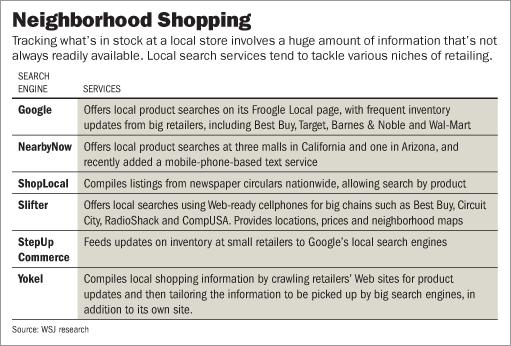
Search Engines Help Shoppers To Buy Locally
By JAMES COVERT
December 21, 2006; Page B1

Now that shoppers are accustomed to scouring the Web for the best prices on everything from TV sets to handbags, a new breed of search engine aims to help them figure out which local stores have the goods in stock.


Last week, a company called NearbyNow began offering shoppers at three malls in California and one in Arizona a chance to check merchandise availability at most of the malls' stores by sending text messages from their cellphones. A similar service called Slifter, from GPShopper Inc., focuses on the availability of electronics and toys at big chains like Best Buy Co. and Staples Inc. Other companies, including Google Inc., are building networks to help shoppers figure out what's at local stores before they get there.

For some shoppers, the services have come in handy. Kharlo Barcenas, a 24-year-old construction-project engineer, says he used NearbyNow's service to quickly locate an Oakland As baseball cap at the Eastridge mall in San Jose, Calif., on Sunday. Since hearing about Slifter at a party in the spring, Jacob Silberstein, a 33-year-old legal recruiter from Queens, N.Y., has used it to buy a router at Circuit City and an iPod armband and a "Lord of the Rings" DVD set at Best Buy. "Some people see it and immediately get it," he says, noting that he has introduced the service to a half-dozen friends.

Online local searches have been around for a while, but they have been hit or miss, largely because inventory information at the store level is hard to get. A site called Yokel.com, for example, does a far better job of finding merchandise in its hometown of Boston than elsewhere around the country. Yokel Inc. Chief Executive Scott Randall says it will take a year for the company to cover the nation's 25 top metropolitan areas as well as the service covers Boston. And Shoplocal.com, one of the largest local shopping sites, plans to overhaul its site early next year to better highlight the local offerings it gathers from newspaper advertising circulars. Right now, those offerings are often mixed in with online deals.

It's been especially hard to collect information about designer clothes. In January, a site called BrandHabit.com plans to launch such a service. The hitch: It will focus on small designers and boutiques that are willing to participate because they need the exposure.

Some major retail chains that let customers check inventories at local stores on their own Web sites are also starting to share that information with search engines. And Google is working with Best Buy, Barnes & Noble Inc., Target Corp. and Wal-Mart Stores Inc. to make those chains' inventories more accessible online. Over the past year, its Google Base and Froogle Local programs have also amassed local inventory feeds from smaller businesses. Best Buy is involved because "it's really a convenience factor" for shoppers, says Rose Hamilton, the company's director of online marketing.

But a number of retailers, including some luxury stores, apparel chains, jewelers and supermarkets, aren't enthusiastic about making the information available. One reason is that the searches list prices, sometimes side by side with lower prices available online. Gap Inc. has "no immediate plans to implement it for a variety of reasons," says spokesman Alex Clark, adding that "there are some logistical difficulties to say the least."

NearbyNow was able to persuade retailers at the four malls it covers to participate in part because it shows only local results, says Scott Dunlap, founder and CEO of the Mountain View, Calif., company. By this time next year, he expects the service, which is free to shoppers, to be available for at least 100 malls. "It's a big hit with the teen 'mall rat' demographic" and chains like American Eagle Outfitters Inc. and Hot Topic Inc., Mr. Dunlap says. He adds that NearbyNow plans to offer information about new merchandise and markdowns starting this spring. "These kids do everything on their phones," he notes. American Eagle had no comment. Hot Topic didn't return phone calls seeing comment.

Companies eager to win more Web exposure for their products are helping to nudge the process along. Microsoft Corp., Eastman Kodak Co. and Intel Corp., which track inventories at some smaller retailers, are feeding the data to Channel Intelligence Inc., Channel says. The Celebration, Fla., company says it also collects local inventory information from chains like RadioShack Corp. and CompUSA. Channel then passes the data on to companies like CNET Networks Inc., a tech-oriented shopping-comparison site, and GPShopper.

GPShopper's Slifter service, which is aimed at techies and videogame enthusiasts, covers about 50 million products at 15,000 retail locations, GPShopper CEO Alex Muller says. He aims to expand into sporting goods, apparel and cosmetics. Other companies see an opportunity to publish data from smaller mom-and-pop stores. Over the past three years, StepUp Commerce Inc., based in San Francisco, has built a roster of about 5,000 small retailers that mainly sell appliances, furniture, high-end electronics and other items that aren't easily shipped. StepUp was recently acquired by Intuit Inc., which in October began including the local search service as an option in its Quickbook accounting packages.

At Leland Fly Fishing Outfitters LLC in San Francisco, year-over-year sales of rods, reels, waders and other gear have jumped nearly 50% since the shop began using the new service, says owner Josh Frazier.

But even Google hasn't always had an easy time collecting data. "It's evangelism and education more than trying to sell them anything," says Shailesh Rao, the director of local search for the Mountain View, Calif., company.

Tuesday, December 05, 2006

Business Networking is EXPLODING!

As you all know, our friends at Fast Pitch! www.fastpitchonline have become a premiere destination for business professionals looking to market and network their business.

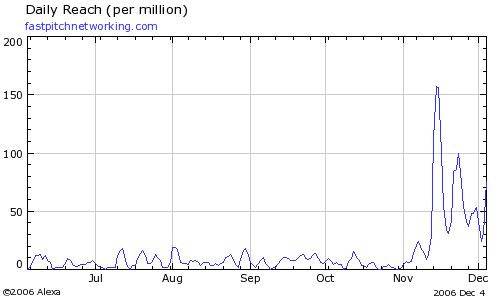
Over the past month, they have climbed the charts, and are now one of the top 20,000 websites (based on last month's traffic). This is an amazing milestone, even if business networking is the hottest thing on the web today. Check out Fast Pitch! traffic exploding on the right - Courtesy of Alexa Rankings.

Another light was casted on this new market by Business 2.0 this week, when they featured LinkedIn (one of the leaders in business networking) - and wrote a very informative article about the expected growth in this space.

A great quote by Reid Hoffman (founder of LinkedIn and infamous founder of Paypal which was sold to eBay for 1.5B) talks about the difference between social networking and business networking on the web - "Once we get them, we can keep them from the age of 25 to 65, the time when people are most valuable, when they are out changing the world," Hoffman says. "I want to be the service for them."

Hoffman refers to the massive trend of Social Networking sites like FaceBook and mySpace, and why business networking should reach a higher plane on the web.

Were are excited to see whats around the corner for Fast Pitch! and this market.

Friday, November 03, 2006

FastPitch kicks into High Gear

FastPitch (www.fastpitchnetworking.com) kicked into high gear this week. They launched a new marketing service for their customer base, and is being featured in a variety of publications and websites.

Check out this PODCAST interview with PR Web Download Podcast

Saturday, October 28, 2006

Web 2.0 - Where is the Business model?

As many of you know, there is a second generation of web-based businesses that are making the dreams of .com boom a reality. What is different? Well actually... not much. Many of the concepts that are proven to be successful in capturing buzz today, were available in the late '90s. For example, Skype (an internet-based VOIP service) is not the first to market. There were a series of Internet Phone products prior to Skype. Companies like FaceBook, mySpace and other social networking companies are not exactly "new" either. There were many websites that allowed you to join communities and post your thoughts. But again, they weren't able to capture the attention of the mass market. I am sure some of it is due to timing, and the lessons learned from Web 1.0... but I question whether we have actually followed through with the most important lesson of Web 1.0 - where is the revenue coming from?

When I look at the overwhelming success UGC (user generated content) sites over the past few years (Digg with news, FaceBook with college kids, mySpace with ???) - I see the classic paradigm of the Internet. You can deploy a great service to lure the masses, but once you try to monetize the user base - you put at risk the user experience that made you popular in the first place. The idea of the "Free Internet" has been the limiting factor for many great ideas. Once something isn't free, it becomes yesterday's news. We saw this phenomenon happen in browser wars, P2P file sharing and of course to web-sites today.

So the question is - Can you monetize the masses? The lazy entrepreneur would quickly shout out "Advertising". But I question the viability of this as a revenue model. Sure, you can make money throwing up some banners and pay-per-click ads on the right side (ala Google). But in reality - even websites with thousands of visitors find it hard to turn traffic into real money. Why? Two reasons. First, the top 100 sites on the web dominate the ad budgets. 90% of the money being spent on "premium advertising" is going to a very small percentage of web publishers. Second, the mass market is not advertising yet. Much like only the top websites get the big as dollars, only the big advertisers are making massive ad buys. So even though you seen billions of dollars being spent on internet advertising, the money is going back and forth between the people who live at the top of the mountain.

So that leaves the other option - Pay-Per-Click advertising. Forget trying to tap into the budgets of the big advertisers and leverage a channel like Google Ad Words or Yahoo Overture. Unfortunately, the picture becomes more bleak. First of all, these guys pay out a very small percentage to their publishers. The model is completely in their favor. They are selling an over-priced ad to an ad buyer, and delivering the ad to a new channel at no cost... and when someone clicks on the ad they take a small percentage and pay for the right to show ads on your site. In my opinion, the cost/value proposition is inverted, and some degree mis-represented to both the advertiser and web publisher. Without digressing into a rant against these guys, I just summarize in saying "Pay Per Click" as a revenue model is a nice way to get beer money from your popular blog, but it is not a revenue model.

So - how are all these Web 2.0 companies going to make money? In my mind - there are only two paths. The first path is to build a large enough base of users and either partner with one of the big guys. For example, YouTube became the dominating force in online video - but I question they could ever monetize their traffic on ads alone. When Google bought them, it gives them the foundation to build a revenue model. If YouTube stayed independent, they would be forced to insert ads into videos (which would destroy the user experience) or charge a ridiculous amount of money for those 2 or 3 banner ads (which would barely cover their bandwidth costs). As part of the Google family, they are simply another block of content that will be distributed through their heavily traffic ad-supported network.

The second path to money for these companies - is to build a community of buyers and sellers. What do I mean? Well, look at some of the examples we have talked about. FaceBook and mySpace - clear leaders in the online community space, but not a community of buyers and seller (yet). Today, its a bunch of kids building content, and sharing thoughts and ideas (and of course pictures of them getting wasted at the football game). They are not selling anything, and no one is really looking to buy. It is simply a social community. Look at YouTube, same thing.

So what do I mean by community of buyers and sellers? It is a business network. Where people become part of the community with the desire to do business (either act as a buyer or seller). A classic example of this - is eBay. eBay was the first example of how you can build a community that has mass appeal, and attract users who are looking to transact, and not just post content or chat.

Another example (which I have a personal bias for since I am an investor) is FastPitch. FastPitch is a destination for small businesses to share leads, market their business and network within their own communities. FastPitch drives revenue through premium membership services that allow small businesses to extend their web marketing and highlight their business in the online community. There is a clear value proposition for a fair price.

So its time to conclude this blog into a point. My point is this - I think we have learned many lessons, and thus Web 2.0 is definitely a stronger, faster, better Internet - but I still feel it has some "bugs" - so I encourage everyone to avoid buying into the "vision" of Pay-Per-Click Internet - because it will eventually be revealed as what it is - high-cost, low value web-based version of classified ads. I am not saying PPC ads will die - but I hope for everyone's sake that the web publishers take back the wheel - and not let the Google's and Yahoo's of the world monopolize the advertising dollar.

Whatever happens... we can all rest assure that Web 3.0 is right around the corner.